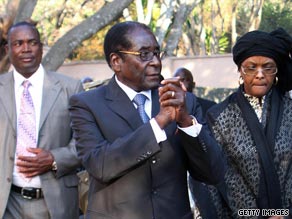
Zimbabwe President Robert Mugabe has condemned "bloody whites" for meddling in his country's affairs and attacked the West for trying to impose its rule on the southern African nation.
Zimbabwe President Robert Mugabe met with a delegation from the European Union.
Mugabe's comments on Friday came a day before he met a delegation of European Union representatives who are in the country to ease relations and push progress on Zimbabwe's political reforms.
Mugabe, 85, welcomed the delegation Saturday "with open arms," news outlets reported.
Addressing his ZANU-PF party's youth conference in the capital of Harare on Friday, Mugabe indicated a tougher stance.
"We have stood firm, and we have refused to let go," Mugabe said. "Sanctions or no sanctions, Zimbabwe remains ours."
The European Union imposed travel bans onMugabe and his representatives in 2002. The bans followed Mugabe's accusations of violations of human rights and rigging of an election.
Attorney General Eric Holder took heat this week for doing something that most Black elected officials are simply not willing to do: He told the truth about race. During a Black History Month speech, the Attorney General lost some major political points by stating that when it comes to discussing race in America, we have become “a nation of cowards”. I couldn’t have been prouder, for you have to be pretty damn brave to admit that we are as cowardly as we are.
I watched the words roll out of Holder’s mouth like steamy breath pouring out on a cold winter day. I simply couldn’t believe it. Eric Holder wasn’t just speaking about Black History, he was MAKING Black History. While everyone looks to the first Black President to deliver something other than Ebony magazine covers, I am also looking to see if the first Black Attorney General can deliver some real progress on a justice system that has mutilated Black families across the nation.
Sure, being the first Black Attorney General is a nice accomplishment, almost cute. I don’t use the word “cute” to demean the significance of Holder’s achievements, but far too many African Americans are focused on obtaining such accolades in America as long as they remember to never really use their prominence to make a difference. You are given the keys to the vault as long as you firmly agree to keep the keys out of the reach of the Black masses. You are not to mention race in any meaningful way, and if you do, you’ll get body slammed, even by the most liberal among us. Racism in America is deep, and the disease has the greatest impact on those who think they’ve been cured.
Don’t believe me? Just answer this question (I say this as someone who likes Barack Obama and voted for him): When was the last time you heard President Barack Obama even say the words “black man”, “black men”, or “black male” in any forum other than a Black event? Instead, you only hear him speaking for the middle class and gleefully indulging us with borderline ridiculous and hyper-redundant comparisons to Abraham Lincoln (who is given far too much credit for the ending of slavery). Were he to compare himself to Martin Luther King or even acknowledge the existence of Malcolm X, he would be crucified for it. President Obama is allowed to humiliate and chastise Black men in speeches about personal responsibility, but he would be severely punished if he were to give those same speeches to the masses of Americans who have squandered their wealth and helped to destroy our financial system (especially those on Wall Street). He speaks on Black men needing to take accountability in spite of urban Black male unemployment rates as high as 40%, while he uses policy support and massive spending to coddle a nation dealing with 7.4% unemployment. I say all this as a fan of Barack Obama, but I also say this as a man who believes that the hard work on racial equality must be done by those in power if we are to ever have a chance of fulfilling Dr. King’s dream. This does not imply that Barack Obama does not believe in racial equality. It is to say that he is likely being told that discussing the truth on race in America will get him into serious trouble. Even if you are not a coward yourself, you are forced into taking cowardly positions on honest racial dialogue when you realize that the punishment for such engagement is incredibly steep.
I know what Eric Holder was talking about in that speech. I know that the price for speaking honestly on race is high, for I pay it every day on my own campus (I will probably pay it for writing this article). Every day, I witness conversations being had around the dinner table that most Black people know they cannot have in public. Eric Holder, by virtue of his willingness to bring the dinner table conversations into the public eye, has now joined me in the group that has been labeled to be “bad angry Black men”.
Being labeled as the “Angry Black Man” can be sad and hurtful. It doesn’t matter how nice you are. I can be as friendly and personable as I want, but the truth of the matter is that if you speak openly about the mass incarceration of Black males, the horrific conditions of inner city schools or the massive unemployment rates of Black males across America, you are going to be attacked and discredited for it. I saw Lou Dobbs (CNN’s version of Bill O’Reilly) mention that he doesn’t feel that Holder is “passing the test” to be qualified as Attorney General, all because Holder made one strong statement about racial equality, one that Martin Luther King would agree with wholeheartedly. What is saddest about our nation is that we have a long history of crucifying those who’ve pushed hardest for our country to advance its racial dialogue. The response to such conversation is as predictable as a dog in front of a bowl of Puppy Chow.
I once recall mentioning the idea of having a prominent Black scholar come to my campus to speak on the social implications and questionable capitalist incentives of mass incarceration and stock ownership in the prison industry. This was a Finance topic, and I am a Finance professor. The idea was shot down immediately by another Black man who felt it would scare the people on campus. When I do CNN interviews on matters related to race, higher administrators on my campus celebrate interviews by other faculty while pretending that my interview never happened. Black scholarship is considered to be “ghetto scholarship”, because those evaluating the quality of such work are typically those who understand or appreciate it the least. The issue of race is demeaned to being a footnote of worthless banter by those who need to learn to keep their mouths shut.
Where Eric Holder and I differ is that he is far more courageous than me. He has decided that he can both be the Attorney General of the United States and speak honestly on behalf of African Americans. I gave up on being a campus Dean, President or high ranking government official a long time ago, since I enjoy the freedom of speech that comes with academic marginalization. I run my own business so that no one can control me financially and pull the suffocating purse strings that cause the rest of us to keep the truth in our pockets. The funniest part of it all is that every piece of historical evidence says that we are simply engaging in the same denial as the previous generation. When I was approached about joining the Obama Administration, I immediately said no – I love Barack to death, but I am not interested in being controlled by lies and pandering. I am not sure what Eric Holder was trying to do with his statement, but I am incredibly proud of him and I hope his statement is a signal regarding how he will conduct business as The United States Attorney General. Our country should be absolutely ashamed of the way it has dismissed Black men in the prison system, giving them longer sentences for the same crimes, disenfranchising them from the rest of the world and using the criminal justice system as a path to modern day slavery. If only we could get liberal groups to be as passionate over this injustice as they are about saving the environment. Perhaps then, meaningful and mutually respectful multi-racial coalitions can exist.
Eric Holder, you have my respect. Unfortunately, not everyone is going to feel that way. Yes, you are right, we are a nation of cowards, and until we gain the courage to have honest conversations, we are always going to be plagued by race. Dreams (like that of Dr. King) are created while we are sleeping. But these dreams are fulfilled when our eyes are wide open and we are wide awake. Wake up America…..it’s time to be honest.
Dr. Boyce Watkins is a Finance Professor at Syracuse University and author of “What if George Bush were a Black Man?” He makes regular appearances in national media, including CNN, ESPN, BET and CBS. For more information, please visit www.BoyceWatkins.com.
Eric Holder, the nation's first black attorney general, said Wednesday the United States was "a nation of cowards" on matters of race, with most Americans avoiding candid discussions of racial issues. In a speech to Justice Department employees marking Black History Month, Holder said the workplace is largely integrated but Americans still self-segregate on the weekends and in their private lives.
"Though this nation has proudly thought of itself as an ethnic melting pot, in things racial we have always been and I believe continue to be, in too many ways, essentially a nation of cowards," Holder said.
Race issues continue to be a topic of political discussion, but "we, as average Americans, simply do not talk enough with each other about race."
Holder's speech echoed President Barack Obama's landmark address last year on race relations during the hotly contested Democratic primaries, when the then-candidate urged the nation to break "a racial stalemate we've been stuck in for years" and bemoaned the "chasm of misunderstanding that exists between the races." Obama delivered the speech to try to distance himself from the angry rhetoric of his former pastor, the Rev. Jeremiah Wright.
Despite President Obama's vow to open government more than ever, the Justice Department is defending Bush administration decisions to keep secret many documents about domestic wiretapping, data collection on travelers and U.S. citizens, and interrogation of suspected terrorists.
In half a dozen lawsuits, Justice lawyers have opposed formal motions or spurned out-of-court offers to delay court action until the new administration rewrites Freedom of Information Act guidelines and decides whether the new rules might allow the public to see more.
In only one case has the Justice Department agreed to suspend a FOIA lawsuit until the disputed documents can be re-evaluated under the yet-to-be-written guidelines. That case involves negotiations on an anti-counterfeiting treaty, not the more controversial, secret anti-terrorism tactics that spawned the other lawsuits as well as Obama's promises of greater openness.
"The signs in the last few days are not entirely encouraging," said Jameel Jaffer, an attorney for the American Civil Liberties Union, which filed several lawsuits seeking the Bush administration's legal rationales for warrantless domestic wiretapping and for its treatment of terrorism detainees.
It is a quick, sweet victory for the new president, and potentially a historic one. The question now is whether the $789 billion economic stimulus plan agreed to by Congressional leaders on Wednesday is the opening act for a more ambitious domestic agenda from President Obama or a harbinger of reduced expectations.
President Obama and Gov. Tim Kaine on Wednesday at a parkway project in Springfield, Va., that could get stimulus money.Both the substance of his first big legislative accomplishment and the way he achieved it underscored the scale of the challenges facing the nation and how different a political climate this is from the early stages of recent administrations.
While it hammered home the reality of bigger, more activist government, the economic package was not the culmination of a hard-fought ideological drive, like Lyndon B. Johnson’s civil rights and Great Society programs, orRonald Reagan’s tax cuts, but rather a necessary and hastily patched-together response to an immediate and increasingly dire situation. On the domestic issues Mr. Obama ran and won on — health care, education, climate change, rebalancing the distribution of wealth — the legislation does little more than promise there will be more to come.
In cobbling together a plan that could get through both the House and the Senate, Mr. Obama prevailed, but not in the way he had hoped. His inability to win over more than a handful of Republicans amounted to a loss of innocence, a reminder that his high-minded calls for change in the practice of governance had been ground up in a matter of weeks by entrenched forces of partisanship and deep, principled differences between left and right.
In the end, Congress did not come together to address what Mr. Obama has regularly suggested is a crisis that could rival the Great Depression. What consensus has been forged so far is likely to be tested in the months to come as he faces scrutiny over the effectiveness of the stimulus package and the likelihood that he will have to ask Congress for substantially more money to heal the fractures in the financial system.
So this was hardly a moment for cigars.
If this is the 21st-century version of Franklin D. Roosevelt’s 100 Days, Mr. Obama seems to be pursuing it more as an urgent but imposed necessity than as a self-selected mission.
While he has deployed his political capital freely to win approval of the package and to begin pushing his version of a financial-system rescue, he has left little doubt that he is eager to move on to the rest of his domestic agenda. At his news conference on Monday night, Mr. Obama said with a hint of exasperation that a costly economic rescue package “wasn’t how I envisioned my presidency beginning.” Regardless of the government’s budgetary straits, Mr. Obama has signaled that he sees his other signature initiatives not just as salvageable but as more urgent than ever.
WASHINGTON, (AFP) - Black Panther-turned human rights campaigner Mumia Abu-Jamal has requested a retrial on his conviction of murdering a police officer, after his death sentence was overturned in March, his lawyer said Sunday.
A three-member Philadelphia appeals court on March 27 voted two-to-one to overturn the former radio journalist’s death sentence, while upholding his conviction for the 1981 murder of Daniel Faulkner.
The court said Abu-Jamal, 54, should face a new sentencing hearing or have his sentence commuted to life in jail.
Abu-Jamal, 54, has always claimed his innocence while on death row for 25 years. While in jail, he became a leading campaigner against the death penalty.
In his request for a retrial, Abu-Jamal’s lawyer Robert Bryan asked for a decision by a full panel of 12 judges, not a three-member court like Philadelphia’s…
A year ago, there was speculation that former shoe company czar Sonny Vaccaro was set to go barnstorming over in Europe with a group that would include O.J. Mayo, Bill Walker and a few other elite players coming out of high school. At the time, it seemed pretty far-fetched that an American-born player would bypass the college experience to play in anonymity outside his home country.
It didn't end up happening, but now it appears as though Brandon Jennings, arguably the top incoming freshman in the country, could become a trendsetter of sorts and opt for overseas money over a one-year college experience at Arizona.
"He's definitely considering it," said Kelly Williams, the father of New Jersey Nets point guard Marcus Williams and also a close advisor to the Jennings family. "Why wouldn't he?"
"If it's a sweet enough deal, why wouldn't he look into it?" Williams added. "But there's nothing definitive right now. They are in the process of investigating it, but he's not going to go just to become the first kid to go overseas. We're not going to put him in a bad situation. We'd try and put him in a situation where he can grow and develop."
Jennings first hatched the idea from Vaccaro, who is on a personal crusade against the NCAA and NBA because of the restrictions that those organizations impose on young basketball players.
Jennings' camp said that whether or not he achieves the SAT score (he's expected to get the results of his latest test any day now) that will make him eligible to play college ball at Arizona is irrelevant with regards to his decision to play overseas.
Interview with Harvard fellow, Peniel E. Joseph, by Tolu Olorunda.
Peniel E. Joseph is one of the nation’s leading scholars of African American history. Although Joseph’s formal expertise includes the Black Radical Tradition, Pan-Africanism, Black Social Movements, and African American feminism, he is currently embarking on a re-evaluation of the Black Power Movement. Professor Joseph is associate professor of African and Afro-American Studies and affiliate faculty in history at Brandeis University. Joseph is the founder of a growing subfield of historical and Africana Studies scholarship that he has named “Black Power Studies.” Joseph's dynamic presentation style and innovative scholarship, place him on the cutting edge of a new generation of public intellectuals. Joseph’s book “Waiting 'Til the Midnight Hour: A Narrative History of Black Power in America,” was a “Washington Post Book World” Best Nonfiction Book for 2006. It was also a finalist for the Mark Lynton History Prize. It received honorable mention for the 2007 Gustavas Myers Center Outstanding Book Award; and received the inaugural W.E.B. Du Bois Book Award from the Northeastern Black Studies Alliance. It was also a Boston Globe paperback bestseller in 2008. Joseph is currently working on a biography of Civil Rights and Black Power activist, Kwame Ture (Stokely Carmichael), and a study of postwar African American history. For the 2008-2009 academic year, Dr. Joseph will be a fellow at Harvard University’s Warren Center.
I had the pleasure of speaking with Dr. Joseph on a wide array of issues. With topics ranging from politics to culture, and education to sports, he was insightfully-enlightening in his observations:
Thanks for joining us. Can you tell us about your background, and the journey leading up to Harvard?
I’m from New York City, born and raised, and I’m just raised by a single mom. My mom was a trade unionist for 40 yrs in New York City – just retired. So, I was always into social and political activism; I was on my first picket line by the time I was 9 yrs old, so I was always active. I was always interested in Black history, Caribbean history, Asian history and African history, so after college I got my PhD from Temple University. At the same time, I was still involved in community and social activism. I wound up teaching at Arizona State University for a couple of years; then I taught at University of Rhode Island and Stony Brooks University in New York -- which is my alma mater. And now at Brandeis University, but this year, I’m a fellow at Harvard University.
Is the continued presence of Black and Brown intellectuals in Ivy League schools emblematic of any substantive progress for us?
Yes, I think it’s an example of progress, but I also think it that -- well, I’ll do the ‘positives’ first. I think it’s a tremendous example of progress, given the fact that when we think about higher education and academe, especially predominantly white institutions; these we’re set up as spaces for the white, elite and the rich. So as soon as you get any kind of African Americans in there, it’s very positive. And, obviously we owe a lot of these to people like Carter G. Woodson, W.E.B Du Bois and Ida B. Wells; the generation of the 19th and early 20th century intellectuals. Some we’re PhDs and others we’re just organic intellectuals in that degree, such as Marcus Garvey and Hubert Harrison. By the time you get to the 1960s, there’s really a second wave of Black Studies, vis-à-vis the Black Power movement that forces some of these predominantly white institutions to open up their doors, through the implementation of Black Studies majors in programs across the country. So that’s the positive. But the negative is the fact that I think most of these spaces are still overwhelmingly white and racist. So, having Cornel West, Michael Eric Dyson and Manning Marable is great, but at the same time, it provides cover for some of these racist institutions as well.So, you have this representative-nature of Blackness, but you don’t have enough Black Undergraduates, or Graduates, let alone Faculty and Administration; because we are sorely underrepresented in all those categories. It’s the same thing with Senator Obama. You might have a black president, but you might also see a lack of Blackness in the federal judges or the news-media. So, there’s the good and bad to the process.
What is your overall perspective on the Senator from Illinois -- especially being that he hails from your very Harvard?
Well, I’m a critical supporter of Mr. Obama, and what I mean by that is that I support Obama’s candidacy; and at the same time, I think that if he is elected, we have to be very vigilant and very critical. So that we force ‘President Obama’ to publicly confront things like, the Prison Industrial Complex and the pervasiveness/viciousness of institutional racism – locally nationally and internationally. But again, I think that trying to run for president is a hard thing to do.
Do you believe that Cynthia McKinney from the Green Party can help in exerting some ‘progressive-pressure’ upon the political landscape?
I think that Cynthia McKinney is obviously a very progressive person -– whom I admire. I think that when we talk of Cynthia McKinney, a lot of activists get confused with Third-Party runs and Community Organizing. Nowadays, some people think that ‘trying’ a Third-Party run - in and of itself - is community organizing, and there’s a problem there. I think that the bankruptcy of that strategy is shown when you have a candidate like Barack Obama, who’s actually energizing millions of people. The Third-Parties don’t seem to have a parallel-outreach and success. When people like Malcolm X and Kwame Ture would say, “We got to follow the people, because the people are ahead of us;” how come they’re following Obama? Masses of the American people are following Obama.
Do you think Senator Obama’s struggle for the White-House is one which we must all embrace?
I think we should be critically supportive of Barack Obama’s candidacy. We’ve seen a lot of debates over this. We saw Tavis Smiley come out and catch a lot of flak for it. But, I do like the idea of holding Barack Obama accountable, but I also feel that he’s in a very difficult position, because he is the first black man that could actually become president. I think the African American community should embrace his candidacy - but critically - and then really watch what’s going on, and try to influence it within the next four years. And then if our needs aren’t being addressed, we can begin making intelligent calculations on what to do next.
I’m sure you’ve heard of the Father’s Day Speech that he gave last Sunday. Did you have a problem with it, or did you feel that it was indeed a legitimate critique?
Well, certainly the speech was pandering, but if you’re from that background, where you’re raised by a single parent, you realize that you do need to speak to Black Men about this. And I thought Obama did it in a way that wasn’t quite as condescending as the way in which Bill Cosby did it in 2004. You have to talk about the politics of self-responsibility vis-à-vis our failures, and also the system that is perpetuating that failure, and that’s a dialogue that we haven’t had in a really complex way. If you’re speaking of the politics of self-determination, whether it’s Marcus Garvey or the Nation of Islam, you’re supposed take personal responsibility. But, one big issue with a Barack Obama presidency is that he might not be able to preach responsibility all across the board.
In matters of education, how does the next president rehabilitate the dilapidated public school system?
To be honest with you, all the president can do is propose laws to the Congress for passage. Certainly, he can give more money to public schools and have further accountability by putting more ‘teeth’ behind “No Child Left Behind;” but it’s really based on spending bills.
As an expert on issues pertinent to race, what are the major obstacles threatening our progress?
I think the biggest things are probably lack of access to higher education, the Prison Industrial complex and the Criminal Justice System. Unemployment, Violence and drugs also are power-brokers in our stagnancy. And we’re talking of Black Americans who happen to be part of the so-called “underclass.”
Do the recent victories of Tiger Woods and the Boston Celtic (being overwhelmingly black) have any substantial impact upon the lives of everyday black folk?
I think they might be an inspiration to some, but a Barack Obama presidency would be even bigger. You know, sports is different from politics, and I think if you have a black President, it will transform the way a lot of young people look at themselves. And, I think Obama’s presidency would bring about reverberations in other aspects of American society. I think that newspapers and television and media would be forced to re-examine aspects of how they’re made up vis-à-vis the shock of having a Black President.
What is your advice for the average brother and sister trying to gain access to higher education?
The pursuit of literacy would allow you to really excel; because, a lot of us are woefully unprepared after graduation from High School. The way it is now, so many of our people have a star-crossed relationship with school, and it is not perceived as something which would impact their lives. I think that what the older folks have to do is educate the younger ones about our history and the struggle that took place to get to this point. And, I think that can provide a context for a way to move forward in the present.
Once again, thanks for speaking with us Dr. Joseph.
This interview was conducted by Tolu Olorunda, Staff Writer for YourBlackWorld.com